
Around here, “AI” means two things, and the whole point of what I built is connecting them. The first AI is artificial insemination, the reason a single elite bull can shape a whole calf crop. The second is artificial intelligence, the layer I put underneath the decision of which bull that should be. This post is about how those two fit together, and the one design rule that makes me willing to breed real cows off the output.
Table of Contents
The rule: the model explains, the engines compute
Here is the decision everything else hangs on. Every number my system produces, every EPD, every dollar value, every projected calf, every coefficient of inbreeding, comes out of a deterministic math engine. Never the language model. The model’s only two jobs are to pick which engine to run and to explain the result in plain English.
That sounds like a limitation. It is actually the feature. Because the model only ever sees numbers the engines already calculated, it physically cannot hallucinate a $C or invent a percentile. When it tells me a mating projects to a certain marbling EPD, that figure was computed, not generated. I can act on it. If I let the model do the arithmetic, I would be one confident-sounding mistake away from breeding the wrong bull to twenty cows. Wiring it so the model narrates and the math engines compute is the only version of this I trust in a chute.

Plan, execute, narrate
Every question I ask runs through the same pipeline. The model maps my request to one analysis skill plus its arguments, the deterministic engine runs, and then the model explains what came back. Ask it to rank sires for a cow and it calls the ranking engine. Ask it something that needs two steps and it chains them on its own.
The example that sold me: I asked it to rank one cow’s bull options and factor in her pedigree. Without being told how, it ran the pedigree engine first, then fed that into the sire-ranking engine, then synthesized both into one answer. That is the agentic part. I described the goal and it assembled the steps.
The heavy reasoning runs on a top model, Opus 4.8, with high effort and extended thinking, so it actually works through the straw trade-offs before it writes. Routine briefs drop down to a lighter local model. If the big model has a transient failure it retries, and can fall back rather than dying mid-plan. It reconstructs prior turns from a durable log too, so a follow-up like “now score the runner-up” resolves against the real earlier numbers instead of guessing.
What the engines actually do
The math underneath is where the real work happens:
Mating projection builds midparent EPDs and dollar values for any sire crossed on any dam. Confidence banding puts accuracy-based error bars around those projections and flags the shaky ones. And the one I lean on hardest, an inbreeding engine built on Wright’s path coefficients, computes the true coefficient of inbreeding for any pairing.

That inbreeding engine has already saved me from myself. It flagged one cross at 6.35 percent, caught another sire that shared six ancestors with the cow I was considering, and outright disqualified Coleman Easy Decision on one mating at 13.2 percent. None of those straws got ordered. There is also carrier-by-carrier recessive screening waiting on genetic-condition data, and a set of advanced scoring engines, covariance-aware scoring that accounts for correlated-trait drag, risk-adjusted scoring with confidence bands, a constraint solver, and Pareto multi-objective optimization, all now reachable from chat.
The breeding-specific smarts
The generic genetics is only half of it. The parts that make it feel like it understands my operation:
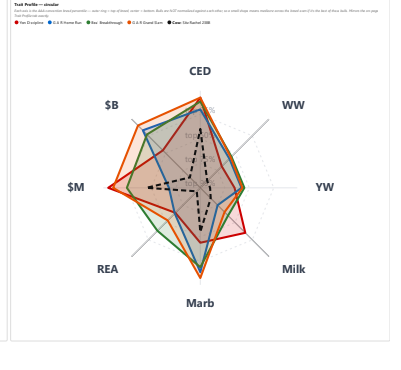
Goal tilt. I told it “mothers and bull-test growth, ignore $EN,” and it re-ranked every cow on a balanced Milk, $M, CEM, WW, YW, RADG weighting instead of just sorting by $C. It is not a single-trait maximizer. It weights toward what I actually want that year.
Tank-aware allocation. It knows my straw inventory, including which are sexed-female and how many remain, and it does a greedy allocation so my best cows claim the scarce sires first. That is how it cracked my five-straw Grand Slam problem: spend four on the top matches, hold one in reserve, send everyone else to Discipline. My handwritten chute sheet came out matching it bull for bull.
Pedigree value the dollar index ignores. It measures seedstock value that $C never captures, high-influence ancestors by descendant footprint, Pathfinder count, cow-family depth. That is what reframed 238B for me. On the dollar index she read as a low-ceiling fallback. On pedigree she read as a maternal-family cow worth breeding for a keeper daughter, so the call flipped to sexed Breakthrough. Most spreadsheets never surface that.
How a real session went
I asked for balanced mothers and growth. It ranked all eight cows on that tilt. It allocated my five scarce Grand Slam straws, four plus a reserve. The pedigree engine reframed 238B toward a sexed keeper daughter. Opus 4.8 wrote the whole plan up and emailed it to me. And along the way it independently caught two inbreeding landmines I had not spotted. When I walked out to the chute with my own handwritten sheet, the plan matched it, animal for animal.

Why I built it this way
I could have pointed a chatbot at my herd data and asked it to “recommend some matings.” Plenty of people are doing exactly that. The problem is you can never fully trust the answer, because the same system that reasons about the numbers is also free to make them up. Splitting those jobs, deterministic engines for every figure, the language model only for choosing and explaining, is what turns this from a toy into something I actually breed cows off of. The computer does the math. I make the call.
