
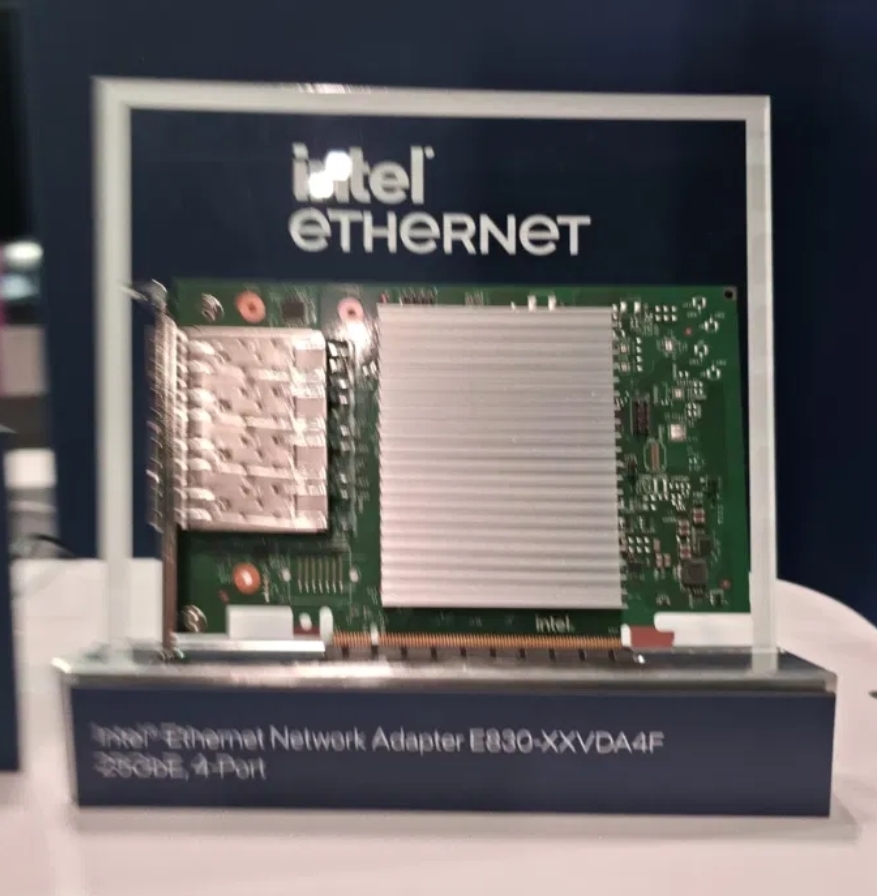
At HPE Discover 2026, surrounded by 800G AI fabrics, the Intel Ethernet Network Adapter E830-XXVDA4F is the card most servers will actually ship with: four 25GbE SFP28 ports on Intel’s E830 controller, with the kind of precision timing and security features that matter more in the real world than another zero on the port speed.
I found it under glass at the Intel Ethernet booth, a plain green board with a big silver heatsink. After a day of 800-gigabit switch trays and liquid-cooled racks, this is the card I actually recognize from the field. Four ports of 25GbE, which is 100 gigabits total, on Intel’s E830 controller, the successor to the E810 that already sits in a lot of servers I have racked.
Table of Contents
Key Takeaways
- The E830-XXVDA4F is a 4-port 25GbE SFP28 PCIe adapter on Intel’s E830 controller, the successor to the widely deployed E810.
- Four 25GbE ports is 100 Gbps of aggregate bandwidth, the mainstream server tier rather than the AI-fabric high end.
- Its real draw is precision timing (IEEE 1588 PTP and SyncE), RoCEv2 RDMA, and modern security with signed firmware, secure boot, and a hardware root of trust.
- This is an HPE-channel option card, sold for use in HPE ProLiant servers.
Specs at a Glance
- Product: Intel Ethernet Network Adapter E830-XXVDA4F
- Controller: Intel Ethernet Controller E830, the successor to the E810
- Ports: 4x SFP28, 25/10GbE
- Aggregate bandwidth: 100 Gbps
- Host interface: PCIe 4.0 x16
- RDMA: RoCEv2
- Timing: IEEE 1588 PTP, SyncE, precision timing follower
- Security: signed firmware, secure boot, hardware root of trust, CNSA 1.0
- Virtualization: SR-IOV, VMDq, VT-c, flexible port partitioning
- Family ceiling: the E830 controller scales up to 200GbE
- HPE-channel list price: around $7,000
The Card
The display put the board face-on, so the heatsink is the first thing you see.

That large finned heatsink sits over the E830 controller, with a second cooler over the port side of the board. For a 100-gigabit card this is a lot of passive metal, which is a fair reminder that a modern multi-port controller is a real chip doing real work, not just a set of cages on a bracket.
What I Could Not Confirm
The placard listed the model and the 4-port 25GbE configuration, but not the host interface or the power draw. I am listing PCIe 4.0 x16 based on the E830 family and the prior-generation 4-port card, so confirm the exact lane width and TDP against Intel’s spec sheet for this part before leaning on them. From this angle I also could not see the four SFP28 cages directly.

Final Words
This is the least flashy thing I photographed all show, and it is also the card I am most likely to actually install. Most servers do not need 800 gigabits. They need a few ports of 25GbE that work, and the E810 this replaces is already in a huge number of machines. Four ports of 25GbE in one slot is a clean way to give a server real bandwidth and some port redundancy without paying for a 100G or 200G part it will never saturate.
The spec that actually caught my eye is the timing. The E830 carries IEEE 1588 PTP and SyncE with a precision timing follower built in. I come from the voice and telecom side, where timing is not a footnote, it is the whole game, and seeing hardware timing this capable on a mainstream server NIC is the part of this card I find genuinely interesting.
It is worth being honest about where this sits. Intel’s networking tops out at 200GbE on the E830 while NVIDIA is shipping 400 and 800G parts, so nobody is building an AI fabric out of these. That is fine, because this is the card you buy for the unglamorous job: 25GbE, strong timing, solid security, and a name your server vendor already supports.
So while everyone photographs the 800G trays, the question worth asking is the one most buyers actually face. Does your next server need an AI fabric, or does it need four 25GbE ports that just work? For most of the racks I touch, it is the second one. Which is yours?
