
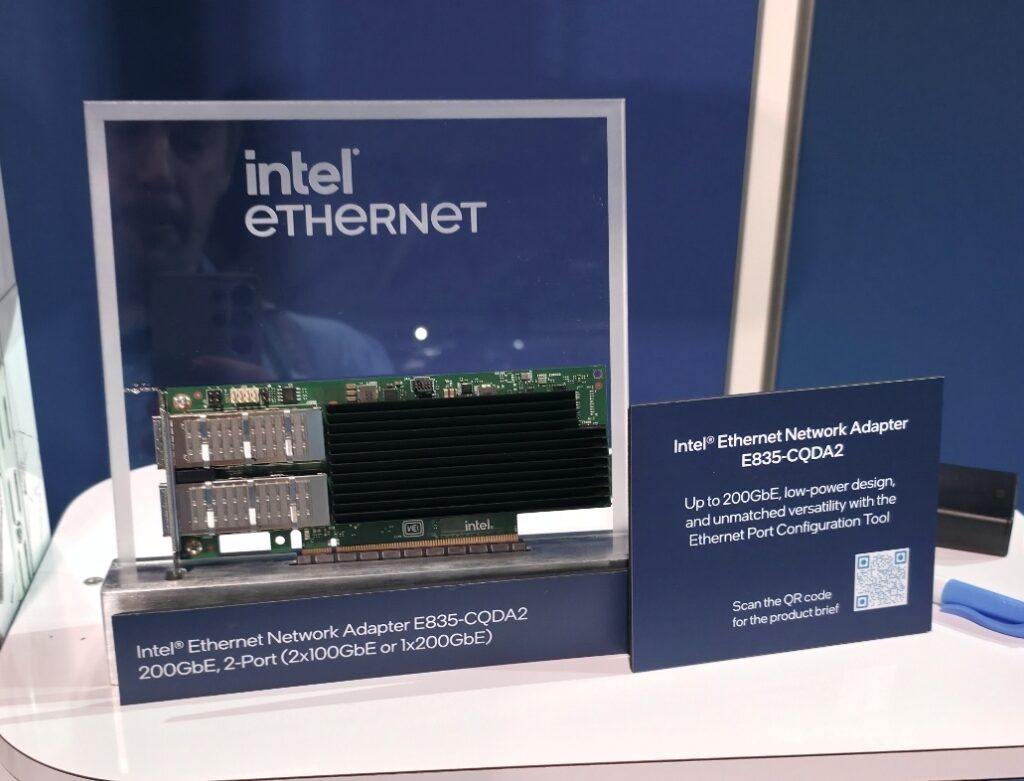
At HPE Discover 2026, Intel’s new E835 lineup is two ends of the same idea: the E835-CQDA2, a 200GbE card that can run as one 200G link, two 100G links, or break out to 25 and 50G, and the E835-XXVDA2, a plain dual-port 25GbE card that costs a fraction as much. Neither is an AI-fabric part. Both are aimed at the ordinary virtualized servers that make up most of this floor’s actual customers.
I caught the E835 cards at the Intel Ethernet booth, a shelf apart. Up top, the E835-CQDA2 with two QSFP cages and a heavy black heatsink. Below it, the little E835-XXVDA2, two SFP28 ports and not much else. I had just photographed Intel’s E830-XXVDA4F one stand over, so the first thing I wanted to know was why Intel now sells both an E830 and an E835. More on that below.
Table of Contents
Key Takeaways
- The E835 lineup spans a configurable 200GbE card (E835-CQDA2) and a low-cost dual-port 25GbE card (E835-XXVDA2), both on Intel’s new E835 controller.
- The CQDA2 reconfigures: one 200G port, two 100G ports, or breakouts down to 50 and 25G, set with Intel’s Ethernet Port Configuration Tool.
- Intel pitches the E835 at dense virtualized servers, claiming up to 1.9x the performance per watt of NVIDIA’s ConnectX-6 Dx and 1.4x of a comparable Broadcom card.
- Even Intel’s fastest here tops out at 200GbE, so this is mainstream server networking, not the 400 and 800G AI-fabric tier.
Specs at a Glance
E835-CQDA2
- Speeds: up to 200GbE. 1x200G on QSFP56, 2x100G on QSFP28, with breakouts to 50 and 25G
- Ports: 2x QSFP
- Controller: Intel Ethernet Controller E835
- RDMA: concurrent iWARP and RoCEv2
- Host interface: PCIe 4.0
- Design: low-power, configured with the Intel Ethernet Port Configuration Tool
- Intel claim: up to 1.9x the performance per watt of NVIDIA ConnectX-6 Dx, 1.4x of Broadcom BCM957508
E835-XXVDA2
- Speeds: 25/10GbE, 2-port SFP28
- Features: RDMA, DPDK, Dynamic Device Personalization
- Price: ServeTheHome put the recommended price of the dual 25G part at roughly $216 or under
The 200G Card: E835-CQDA2
The CQDA2 is the one Intel wants you to look at, and the heatsink shows why.

Two QSFP cages, a long black fin stack over the controller, and a card that does not commit to one port layout. With the Ethernet Port Configuration Tool, the same hardware becomes a single 200G pipe, a pair of 100G links, or a handful of 25 and 50G ports off breakout cables. For anyone who stocks server NICs, one SKU covering all of that is the actual selling point.
The Rest of the Shelf
One shelf down sat the other end of the line.

The E835-XXVDA2 is the plain one: two SFP28 ports, 25GbE, with RDMA, DPDK, and Dynamic Device Personalization to keep CPU overhead down. At a recommended price in the low couple-hundred-dollar range, it is the volume card, the one that actually ends up in racks by the pallet. The CQDA2 gets the booth lighting. The XXVDA2 gets the purchase orders.
So Why Both E830 and E835?
This is the question I walked up with, because I had just shot the E830-XXVDA4F at the next stand. Both families top out at 200GbE. The cleanest read I can give from the booth is that the E835 is the newer launch, tuned for dense virtualized servers and led with a performance-per-watt pitch, while the E830 leans harder into precision timing. Even up close, the line between the two is not obvious, and that is worth saying plainly rather than papering over.
What I Could Not Confirm
The placards gave the models and port configurations but not the host interface. I am listing PCIe 4.0 for the CQDA2 based on the E835 family and the coverage so far, so confirm the exact generation and lane width against Intel’s spec sheet. I also could not confirm whether the E835 carries the same precision timing follower features as the timing-optimized E830 parts, or pin down the precise functional split between the two families.
Final Words
The CQDA2 is the interesting one for anyone who actually orders server NICs. One card that can be a single 200G link, two 100G links, or a set of 25 and 50G breakouts means fewer part numbers to stock and a NIC that adapts to whatever the top-of-rack switch wants. That flexibility is worth more in the field than any spec-sheet record.
Intel’s headline is performance per watt, with a claim of up to 1.9x NVIDIA’s ConnectX-6 Dx. It is worth reading that carefully. The ConnectX-6 Dx is a prior-generation NVIDIA part, and NVIDIA is now shipping 400 and 800G with ConnectX-7 and 8. So the claim is real, but it is a mainstream-versus-mainstream comparison, not Intel catching the high end. For the servers most of us actually buy, mainstream is the right fight to pick.
I deploy this class of card, so the E835 lands as a practical lineup rather than an exciting one, and that is meant as a compliment. A flexible 200G card on top, a cheap 25G card underneath, and a controller with both flavors of RDMA covers the large middle of the market that never needed an AI fabric in the first place.
So the real question the E835 asks is not whether Intel can beat NVIDIA at 800G. It is whether one flexible 200G card, with a cheap 25G one beneath it, is all most of your servers ever needed. Is it all yours need?
