
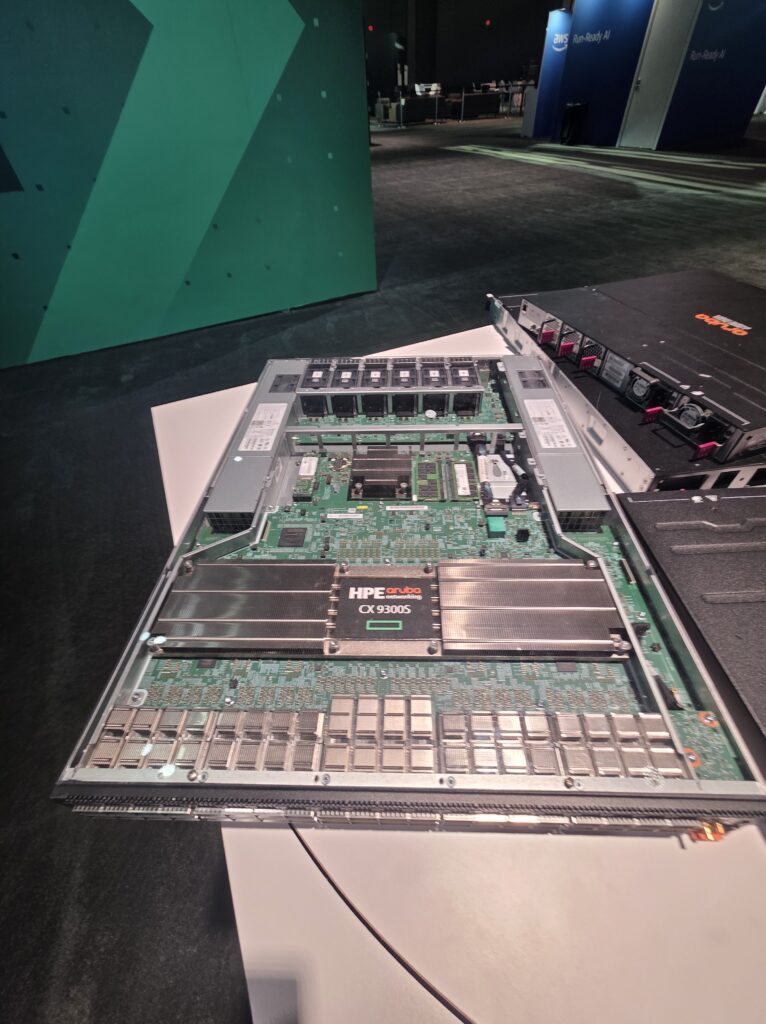
At HPE Discover 2026, HPE had a CX 9300S opened up on the stand with its lid off, which is a rare look inside a shipping-class data-center switch. It is a 16 Tbps, 1U box with 32 ports of 100GbE and 8 of 400GbE, and on the inside it is mostly one giant switching ASIC bolted to what amounts to a small x86 computer.
I hold Aruba CX certifications and I run AOS-CX on much smaller switches, so a 9300S with its cover off was the thing I stopped longest at on my walk through HPE Networking. The 9300S is far bigger than anything I deploy, but it runs the same operating system I already know, and getting to see what is under the lid is not something you usually get on a show floor.
Table of Contents
Key Takeaways
- The CX 9300S is a 16 Tbps, 1U data-center switch: 32x 100GbE on QSFP28 plus 8x 400GbE on QSFP-DD, running AOS-CX.
- The 400G ports break out to 2x200G or 4x100G, and the 100G ports to 4x25G, so one box spans a 25, 100, and 400G migration.
- Inside, it is one large switching ASIC under an HPE-branded lid, plus an x86 control plane with DDR5 ECC memory, an NVMe boot SSD, and an FPGA.
- The unit on the stand was a labeled pre-production prototype marked “Not For Sale,” and the main board carried a 2023 date, so this is a mature design by show time.
Specs at a Glance
- Product: HPE Aruba Networking CX 9300S (9300S-32C8D class)
- Switching capacity: 16 Tbps in 1U
- Ports: 32x 100GbE QSFP28, plus 8x 400GbE QSFP-DD
- Breakouts: 400G to 2x200G or 4x100G; 100G to 4x25G
- Operating system: AOS-CX, with the Network Analytics Engine and Fabric Composer
- Fabric and features: VXLAN BGP-EVPN, BGP, OSPF, VRF-Lite, IPv6, RoCEv2, NVMe-oF, lossless QoS, 9K jumbo frames
- Timing: front-panel 10MHz, 1PPS, and ToD ports for precision timing distribution
- Power: dual hot-swap PSUs, 1600W 80 PLUS Platinum on the unit shown, with AC or DC options
- Cooling: six hot-swap fans, front-to-back or back-to-front airflow
The Front: Ports and Timing
The faceplate tells you what this switch is for before you ever open it.

Along with the QSFP cages, look at the small round connectors labeled 10MHz, 1PPS, and ToD. Those are precision timing ports. A switch that exposes hardware timing like this is built for fabrics where clock accuracy matters, and it is not something you see on an ordinary top-of-rack box.
Lid Off: Mostly One Giant ASIC
Open it up and the layout is honest about where the work happens.

The plate stamped with the product name is not the chip. It is a branded lid sitting on top of the main switching ASIC, with a large finned heatsink on either side. One honest limit of a show-floor look: that lid hides whose silicon is underneath, so I cannot tell you the exact ASIC from a photo. What the layout does tell you is the split. The center is the data plane, and everything around it, the fans, the power, and the small board up top, exists to feed and cool that one chip.
A Switch With ECC Memory
The control plane is where this stops looking like a switch and starts looking like a server.

That is an SK Hynix 32GB DDR5-5600 ECC SODIMM in a socketed slot, with a second slot beside it. ECC memory on the control plane is the right call for something meant to run for years without a reboot. Note the board date too. The main board is stamped December 2023, which on a 2026 show floor tells you this design has been baking for a while.
NVMe Boot, a Coin Cell, and a “Not For Sale” Sticker
A few inches over, the rest of the computer comes into view.

An ADATA industrial M.2 SSD handles boot and storage for the operating system. Next to it sits a Panasonic BR2032 coin cell, the same kind of real-time-clock battery you would find in a desktop. And the yellow label is the giveaway that this was a validation unit: it reads “Not For Sale.” This was a prototype HPE chose to open up, which is exactly why we get to see any of this.
The FPGA Doing the Quiet Work
One more chip is worth pointing out.

That is an Altera Cyclone V FPGA. On a switch like this, a part like that typically handles management-plane housekeeping: board control, sensors, sequencing, and often the timing logic that feeds those front-panel clock ports. It is the kind of chip you never think about until you are the one tracing why a board will not come up.
Power and Cooling
The back half is all about moving watts and air.

Six hot-swap fans sit in a row, each labeled for orientation, feeding the front-to-back airflow. The power supply on the unit was rated 1600W and 80 PLUS Platinum, and there are two of them for redundancy. Everything here is field-replaceable from outside the chassis, which is the part I care about most as the person who would have to service it at 2 a.m.
What I Could Not Confirm
The main switching ASIC is capped with an HPE-branded lid, so I could not read the silicon vendor or model from the unit. The control-plane CPU sits under its own heatsink and was not legible either. I saw one 32GB DDR5 ECC SODIMM and a second slot, but could not confirm the total populated memory. And while the front-panel 10MHz, 1PPS, and ToD ports are clearly there, I did not verify the exact PTP or SyncE feature support tied to them on this specific SKU. Check HPE’s QuickSpecs before relying on any of those.
Final Words
The thing that stuck with me is how ordinary the computer part is. This is a 16 Tbps switch, and the brains running it are a small x86 board with a DDR5 ECC SODIMM, an M.2 SSD, a coin-cell battery, and an FPGA. All the exotic performance lives in one big ASIC under that branded lid. Everything else is a PC that boots Linux and tells the chip what to do.
I run AOS-CX on much smaller switches, so the 9300S is bigger than anything I rack. But seeing the same operating system I know on a 16 Tbps box, and seeing that the guts are this serviceable, with hot-swap fans, hot-swap supplies, a socketed SODIMM, and an M.2, makes it feel less like a sealed appliance and more like something I could actually live with.
It was also honest about itself. A 2023 board date and a “Not For Sale” validation sticker mean this is a mature design being shown, not a mockup dressed up for the booth. That date is its own quiet signal about how long this silicon has been in the works.
So the question the 9300S left me with is the one I keep circling back to with all this gear. When the hard part is one ASIC and the rest is a serviceable little computer, how much of a modern switch is really the hardware, and how much is the software driving it? Where would you put your money?
