
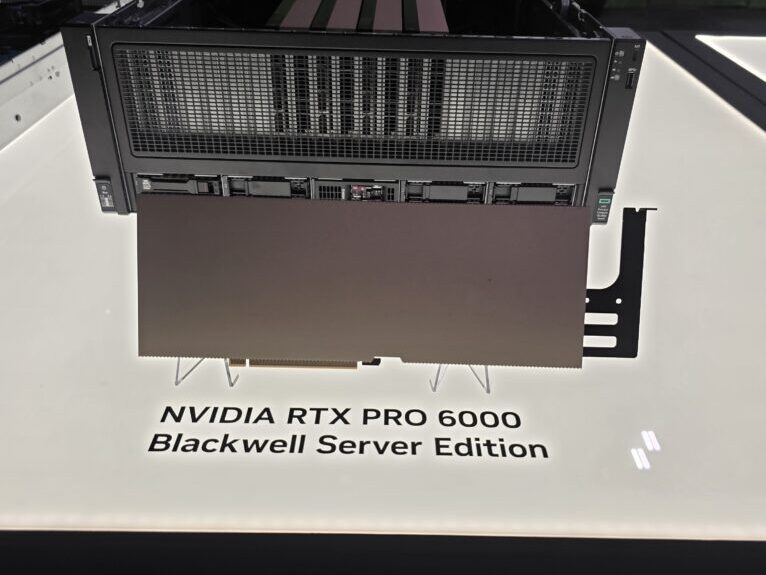
At HPE Discover 2026, the NVIDIA RTX PRO 6000 Blackwell Server Edition is the heavyweight of NVIDIA’s RTX PRO line: 96GB of GDDR7 and 24,064 Blackwell cores in a dual-slot, passively cooled card that pulls up to 600 watts. HPE showed it next to the ProLiant Compute DL380a Gen12, the 4U accelerator server built to hold up to eight of them.
A few feet from the little 165-watt RTX PRO 4500 I wrote about, HPE had its big sibling on the same stand. The RTX PRO 6000 Blackwell Server Edition is the same Server Edition idea scaled all the way up. It is still passive and still display-less, fed by a single 16-pin connector. It just does all of that at 600 watts and 96GB. Behind it sat the server it is built for, the DL380a Gen12, where the “a” means accelerator-optimized.
Table of Contents
Key Takeaways
- The RTX PRO 6000 Blackwell Server Edition is a dual-slot, passively cooled, 600W GPU with 96GB of GDDR7 ECC, the top of NVIDIA’s RTX PRO Blackwell line.
- It runs 24,064 CUDA cores with 96GB at 1.6 TB/s and supports up to four MIG partitions.
- HPE pairs it with the ProLiant Compute DL380a Gen12, a 4U server that holds up to eight of these 600W cards.
- It is the same Server Edition formula as the 165W RTX PRO 4500: no onboard fan, no display outputs, one 16-pin, and the chassis does the cooling. This one just runs it at 600 watts.
Specs at a Glance
- Product: NVIDIA RTX PRO 6000 Blackwell Server Edition
- GPU: Blackwell, 24,064 CUDA cores
- Memory: 96 GB GDDR7 ECC, 512-bit, 1.6 TB/s
- Power: up to 600 W, single 16-pin connector
- Form factor: dual-slot, full height full length, 10.5 in
- Cooling: passive, requires server airflow
- Interconnect: PCIe Gen5 x16, no NVLink
- Multi-Instance GPU: up to 4 isolated instances
- Precision and media: 5th-gen Tensor Cores with FP4, 9th-gen NVENC, 6th-gen NVDEC
- Display outputs: none, this is a server card
- Shown with: HPE ProLiant Compute DL380a Gen12, a 4U server that holds up to 8 of these GPUs
What HPE Put on the Stand
The card sat on a stand in front of an open DL380a Gen12, under an NVIDIA AI Computing by HPE banner.

Note the open server behind it. That is not decoration. A 600-watt passive card has no way to cool itself, so the host is the cooling system, and HPE built the DL380a around exactly that job.
The Card, and the Single 16-Pin
Up close, the design is the same language as the smaller Server Edition cards, just thicker.

Dual-slot, a full passive fin stack, and one 16-pin connector carrying the entire 600 watts. One cable. The connector standard exists precisely so a 600-watt card does not need a fistful of 8-pins behind it.
Built for a Specific Server
Stood on end next to its host, the pairing is the whole story.

The DL380a Gen12 is a 4U box with two of its three power domains dedicated to GPUs. It holds up to eight of these cards, which is the point. This is not a GPU you add to a server. It is a GPU you build a server around.
What I Could Not Confirm
The card was on a display stand, not seated in the DL380a, so I could not see the airflow path or how HPE staggers eight 600-watt cards across the chassis. I also could not confirm the exact power supply configuration on the unit on the floor.
Final Words
Do the math on a full server. Eight of these at 600 watts is 4.8 kilowatts of GPU in a single 4U box, before you add the two 144-core Xeons and the memory. It also adds up to 768GB of GPU memory in one server, which is the number that matters once your models get large.
I work with GPUs for AI and ML, and 96GB is the number I keep wishing I had. It is the difference between quantizing a model down to fit and just loading it. A single 96GB card runs model sizes that would otherwise need two or three smaller cards, and with MIG you can still slice it into four isolated instances when the job is smaller. This is the card I would want.
It is also the card I would have to build a room around. The 4500 was a card you slip into servers you already own. This one you buy a server for. Passive cooling at 600 watts means the DL380a’s fans and its GPU power domains are doing the heavy lifting, and eight of them in 4U is a power and heat density an ordinary server room actually feels.
So the question the 6000 asks is not whether you want 96GB. Everyone wants 96GB. It is whether you have somewhere that can power and cool a 4U box pulling close to 5 kilowatts. Do you?
