
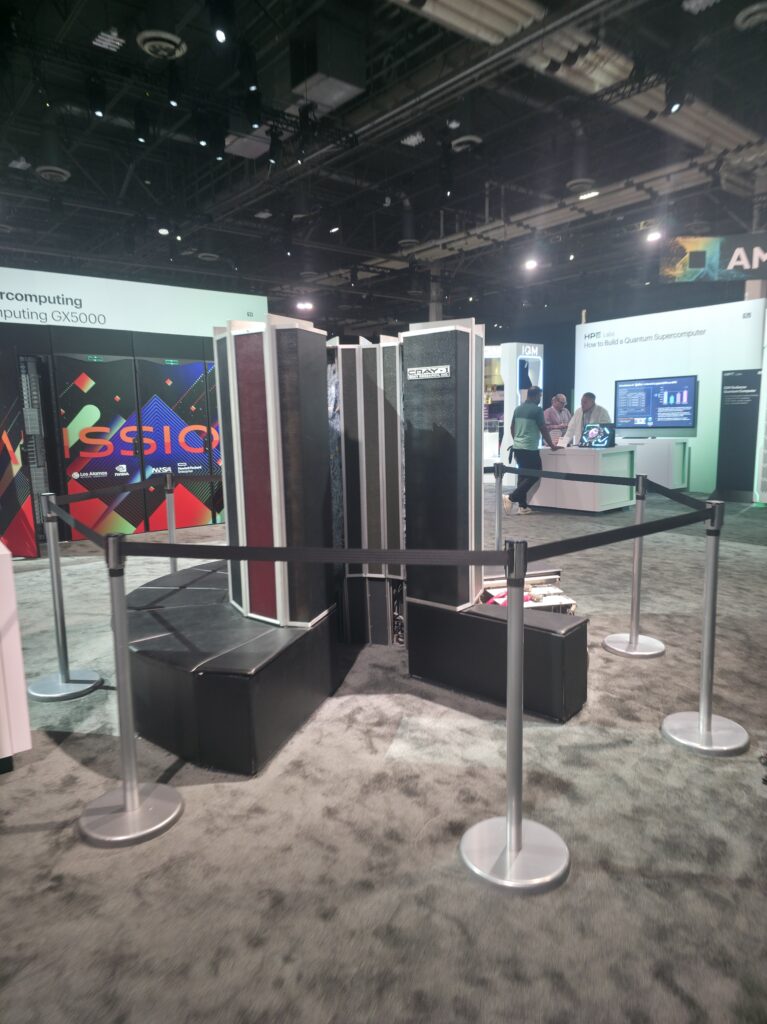
At HPE Discover 2026, one of the most interesting machines on the floor is not a new AI cluster. It is a 50-year-old Cray-1 prototype that helped define what high-performance computing looked like before modern data centers existed.
Walking the floor at HPE Discover this week, among the dense AI systems and modern HPC displays, sits an absolute unit of computing history: the Cray-1. But this is not just any museum piece. This is Serial Number 1, known as SN1, a roughly 11,000-pound evaluation unit that spent its life moving between nuclear labs, weather centers, and government research environments as the ultimate high-performance placeholder.[1][2]
Table of Contents
It is a masterclass in brute-force engineering, built in an era where optimizing a system meant fighting the physical limits of wiring, power, heat, and signal timing.

Layer 1: The Speed of Light and Twisted Pair Spaghetti
The dense internal wiring of the Cray-1 SN1. What looks chaotic was actually part of the machine’s timing strategy.

If you look at the interior column of SN1, it looks like a cabling nightmare. The better description is strict physical-layer timing discipline.
The Cray-1 ran on an 80 MHz clock, which meant a 12.5-nanosecond clock period. At that speed, propagation delay was not an abstract engineering detail. It was the problem. The Computer History Museum notes that the Cray-1 used more than 60 miles of wire and kept wire segments extremely short to reduce signal delay.[3]
Some sources describe the maximum wire segment as about 3 feet, while others describe the design limit as about 4 feet. Either way, the point is the same: the system was physically shaped around timing. The wiring was not just there to connect boards. It was part of the machine’s clock discipline.[3][4]
Every signal path had to land inside a tiny timing window. If a connection only needed to cross a short physical gap, but the matching logic path required more delay, engineers had to account for that in the wire length. Extra wire was not necessarily sloppy work. In many cases, it was timing compensation.
The wiring was also built from twisted pairs. Cray-History.net describes the assembly process for the blue and white twisted wires used in Cray-1 wiring work. Long before twisted pair became everyday language because of Ethernet, Cray was already leaning on twisted wiring to control signal behavior inside a very dense, very noisy machine.[5]

The iconic C-shaped cabinet was not just styling. It helped keep wiring short enough for the system’s timing requirements.
Even the iconic C shape was functional. Bending the racks inward reduced the maximum distance between parts of the system. This was not furniture design first and computer design second. It was packaging, signal timing, cooling, and serviceability fighting for space in the same physical object.
Thermal Management: Those Are Not Seats
The padded ring around the Cray-1 is commonly mistaken for seating, but it concealed power and cooling infrastructure.

There is a persistent myth that the padded ring around the base of the Cray-1 was designed mainly as a seating area for operators. It is understandable. It looks like a bench. The engineering reality is more interesting.
The Computer History Museum describes the bench as concealing the power supplies, and EDN notes that the Cray-1 system and its power supplies consumed about 115 kilowatts. That is not a casual amount of heat to hide under upholstery.[3][4]
You cannot air-cool that kind of density in a cabinet like this and pretend the problem is solved. The Cray-1 used copper plates between circuit boards to move heat into aluminum side channels, where Freon flowing through embedded tubing carried the heat away. The Computer History Museum describes this as part of the Cray-1’s attention to packaging and plumbing, which is exactly what it was.[3]
From a modern data center perspective, the machine is a reminder that liquid cooling is not new. The difference is that the Cray-1 made the plumbing impossible to ignore. Power delivery, refrigeration, chassis layout, and signal timing were all part of the same system design.
“Parity Is for Farmers”: The SN1 Los Alamos Run
The defining technical story of this specific chassis is that SN1 was an early prototype and evaluation system, not a polished production appliance.
Cray-History.net states that SN1 was installed at Los Alamos Scientific Laboratory in March 1976 for prototype testing. It was later replaced in September 1977 by Serial Number 4, a full-million-word machine with automatic error correction. Filibeto’s Cray FAQ similarly notes that SN1 was replaced by SN4, which had SECDED memory protection hardware.[2][6]
That detail matters. SN1 was fast, but it did not yet have the memory protection that later systems would need. At Los Alamos, memory reliability was not theoretical. OSTI’s record of later research on the Cray-1 at Los Alamos describes bit flips in the machine’s bipolar SRAMs and connects the upset rate to atmospheric neutrons, one of the classic ground-level single-event-upset cases in computing history.[7]
Los Alamos sits at high elevation, where the atmosphere provides less shielding than it does at sea level. In that environment, a high-performance machine without modern memory protection was exposed to a problem that is still relevant today: the hardware can be logically perfect and still be physically vulnerable.
SN1 did not retire after Los Alamos. After 17 months there, it was sent to the European Centre for Medium-Range Weather Forecasts, initially housed at Rutherford National Laboratory, while ECMWF waited for its upgraded permanent system. It later served a UK government and MOD customer, then continued through additional research environments before returning to Cray.[2][6]
That is what makes SN1 such a strong exhibit. It is not just old hardware. It is a physical record of the tradeoffs that shaped supercomputing: wire length, propagation delay, power density, refrigeration, memory reliability, and the uncomfortable truth that the laws of physics always get a vote.
Frequently Asked Questions
Did the Cray-1 have error correction?
Later Cray-1 models and configurations did, but SN1 did not have the same automatic error correction hardware that appeared in later systems. SN1 was replaced at Los Alamos by SN4, which had SECDED memory protection hardware.[2][6]
Why does the Cray-1 look like a C or a horseshoe?
The shape was functional. The Cray-1’s physical layout helped keep wire runs short, which mattered because the system ran on a 12.5-nanosecond clock. At that timing scale, cabinet geometry directly affected system performance.[3][4]
Are the pads around the base meant for sitting?
Not primarily. They look like seats, and people have treated them that way, but the padded base concealed power and cooling infrastructure. The Computer History Museum specifically notes that the bench concealed power supplies.[3]
Why are there so many tangled wires inside?
The wiring was part of the machine’s timing and packaging strategy. Short, carefully routed wire paths helped control propagation delay. What looks like a mess was a hand-built physical timing system.
Why is SN1 historically important?
SN1 was the first Cray-1 system and served as a prototype and evaluation unit. It was installed at Los Alamos in 1976, later moved to ECMWF-related service in the UK, and continued through additional research use. It helped prove the design before later Cray-1 systems became permanent installations.[2][6]
Learn More
To go deeper into the Cray-1’s physical engineering, architecture, and SN1’s unusual travel history, start with these sources:
- SN1 history: Cray-History.net’s Serial Number 1 timeline
- Architecture and physical design: Computer History Museum’s Cray-1 Supercomputer page
- Power and thermal engineering: EDN’s Cray-1 power supply breakdown
- Cray technical trivia and installed-base notes: Filibeto.org’s Cray Supercomputer FAQ
- Bit flips and single-event upsets: OSTI record on the Cray-1 memory upset study at Los Alamos
Citations
- HPE Discover Las Vegas 2026, Hewlett Packard Enterprise.
- Serial Number 1 aka SN1, Cray-History.net.
- The Cray-1 Supercomputer, Computer History Museum.
- Cray-1 Super Computer: The Power Supply, EDN.
- Sonja’s Story about Cray-1 Fabrication and Assembly, Cray-History.net.
- Cray Supercomputer FAQ, Filibeto.org.
- First Record of Single Event Upset on the Ground, Cray-1 Computer Memory at Los Alamos in 1976, OSTI.
