
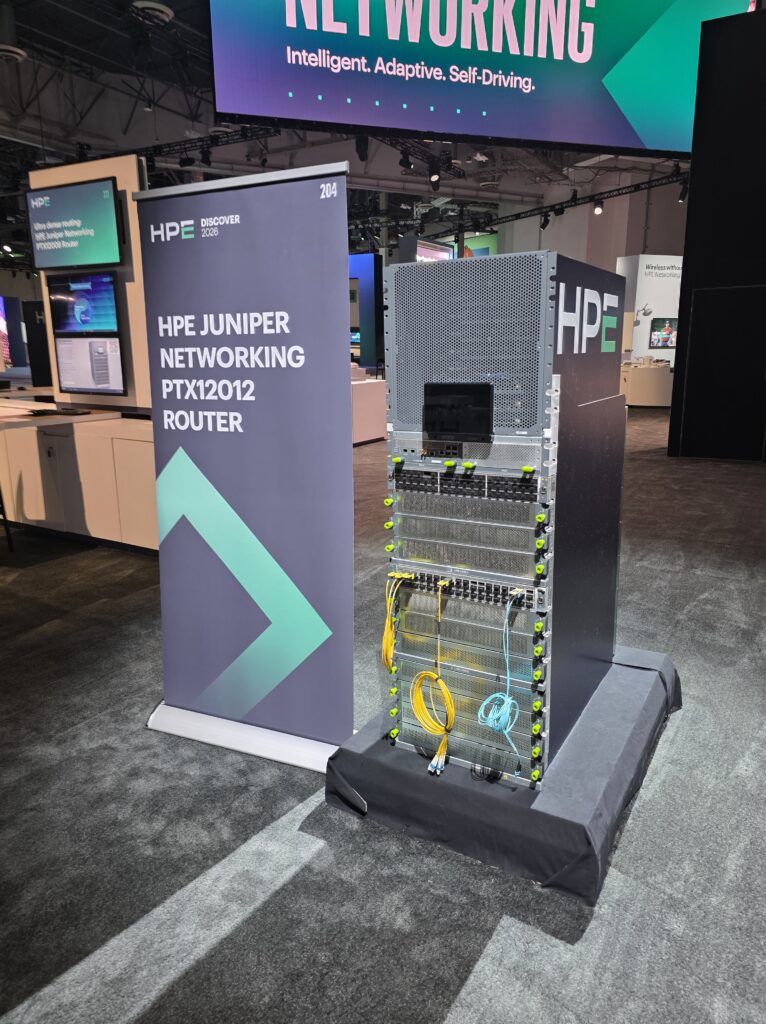
At HPE Discover 2026, the HPE Juniper PTX12012 is the router that makes you look at the power and cooling first. It is a 12-slot, 32U core router that scales to 518.4 terabits and 648 ports of 800G, fed by a back wall of up to 36 power supply modules.
I found the PTX12012 staged next to its own banner at booth 204, a core router HPE built for data center interconnect and AI backbone traffic. The throughput number is the headline, and it is large. What stopped me was the back of the chassis. The rear is an array of power supply bays numbered PSM0 through PSM35, sitting above three columns of fans. This thing routes packets, but the first thing it tells you is that it is a power and cooling problem.
Table of Contents
Key Takeaways
- The PTX12012 is a 12-slot, 32U modular core router that scales to 518.4 Tbps and 648 ports of 800GbE when fully populated.
- Each line card forwards 43.2 Tbps across 54 ports of 800G, built on Juniper’s Express 5 ASIC.
- Power and cooling dominate the chassis: up to 36 power supply modules at 3 kW each, above three fan trays.
- The units on the floor carry DEV-prefixed labels and prototype handles, in line with the PTX12012 shipping in the second half of 2026.
Specs at a Glance
- Product: HPE Juniper Networking PTX12012 Router
- Use cases: data center interconnect, core, peering, AI data center fabrics
- Chassis: 12 slots, 32U
- Capacity: up to 518.4 Tbps
- Ports: up to 648 x 800GbE
- Line card: 43.2 Tbps, 54 x 800GbE, QSFP-DD or OSFP
- Silicon: Juniper Express 5 ASIC, about 49 percent better power efficiency than the prior generation per HPE
- Optics: ZR and ZR+ coherent on 100, 400, and 800GbE, 1.6T-ready
- Power: up to 36 x 3 kW power supply modules
- Weight: up to roughly 772 kg, about 1,700 lb
What HPE Put on the Floor
The PTX12012 sat on a low riser at booth 204, under its own HPE Juniper Networking banner.

The eight-slot sibling, the PTX12008, was referenced on a nearby screen. Same idea, smaller chassis, 345.6 Tbps instead of 518.4.
The Control Plane and the Line Cards
Up front, the chassis runs dual control boards marked RCB 0 and RCB 1, with the PTX12K-RE routing engine and a small touchscreen.

Only a few of the twelve slots were populated. The line cards that were in carried dense rows of 800G cages, and the demo had fiber staged through them: yellow single-mode and aqua multimode patch cords coiled at the front. A full chassis is twelve of these cards, which is where the 648-port number comes from.
The Power Wall
Around the back, the chassis turns into mostly power and air.

The supply bays run PSM0 through PSM35, up to 36 modules at 3 kW each, sitting above three columns of fans that pull air straight through the system. You do not usually photograph the power and cooling first. On this chassis it is the part that decides whether you can install it at all.
Power Input and the Proto Labels
Closer in, you can see the AC inlets feeding the supplies and the fan trays marked FAN TRAY 0, 1, and 2.

The bays and trays carry DEV-26070 labels and prototype handles. That lines up with the PTX12012 not shipping until the second half of 2026, so what was on the floor is pre-production hardware, not a shipping unit.
What I Could Not Confirm
The fan trays show SIB status indicators, which suggests the switch fabric boards sit behind them, but I could not see the fabric cards themselves or confirm how many fabric planes this demo chassis had installed. With only a few slots populated, I also could not confirm the full line card mix.
Final Words
Do the math, because it is clean. Each line card runs 54 ports of 800G, which is 43.2 terabits. Twelve of those is 518.4 terabits, and that matches HPE’s headline. The capacity is port density, not a trick.
The number I keep looking at is the power. Up to 36 supplies at 3 kW each is up to 108 kW of supply capacity in one chassis. The Cray-1 I wrote about earlier drew around 115 kW for a whole supercomputer, so a single modern core router now sits in the same power class.
Here is my honest disclaimer: I do not run 32U core routers or 800G data center interconnect links. My world is production networks in live buildings. But power and cooling are the unglamorous half of every deployment, and this one leads with them. Thirty-six supplies and three fan trays is not a box you wheel in and forget. It is a facilities question about power feeds and floor loading before it is a routing one, and at roughly 772 kg, the floor part is literal.
So before the 518 terabits matters, the real question for anyone eyeing one of these is simpler: is your facility ready for a 1,700-pound router that wants up to 108 kW before it routes a single packet?
